Paper Review | Does a Longer Chain of Thought Make an LLM Smarter?
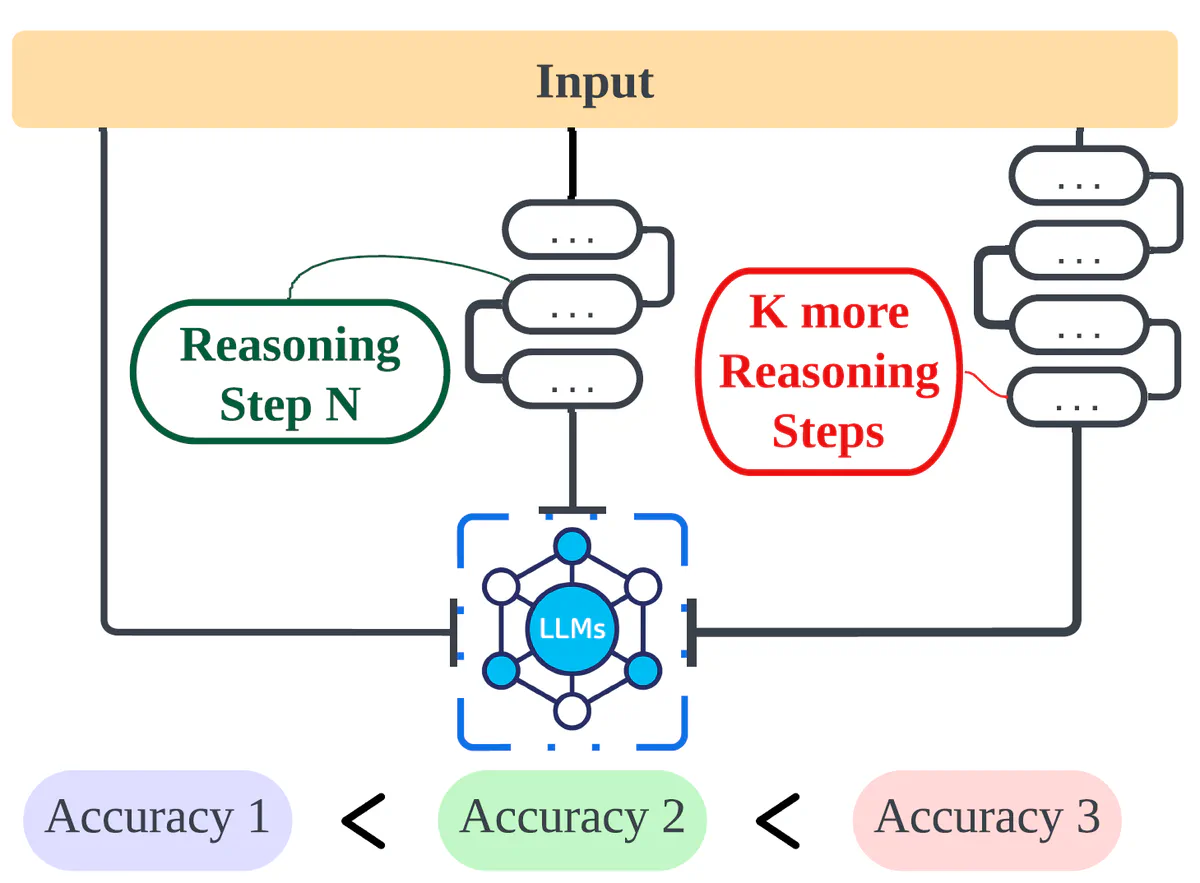
Title: The Impact of Reasoning Step Length on Large Language Models
Institute: Northwestern University, University of Liverpool, New Jersey Institute of Technology, Rutgers University
Authors: Mingyu Jin, Qinkai Yu, Dong Shu, Haiyan Zhao, Wenyue Hua, Yanda Meng, Yongfeng Zhang, Mengnan Du
Arxiv Link: https://arxiv.org/abs/2401.04925
Date: 2024.1.20
Introduction
Chain of thought (CoT) has already proven, in practice, to substantially improve the reasoning ability of large language models. Yet no work so far has explained the relationship between the length of a chain of thought and reasoning ability. This paper takes that question as its core, runs a systematic set of experiments on CoT, and arrives at a number of interesting and counterintuitive conclusions.
Conclusions
Let us skip the preamble and go straight to the conclusions.
- For Few-shot CoT, the accuracy of the model’s answers is linearly related to the number of reasoning steps: the longer the chain, the more accurate the answer. Conversely, shortening the CoT significantly reduces accuracy, even when the shortened chain preserves the same key information as the long one.
- Even when a CoT chain contains incorrect reasoning, keeping the necessary reasoning length still yields good results. In other words, a longer chain improves accuracy even if an intermediate step is wrong.
- Simple tasks need fewer steps; complex tasks need more.
- Even in the Zero-shot CoT setting, adding “you must think more steps” on top of “Let’s think step by step” improves the model’s performance.
Experimental Setup
Zero-shot CoT
The Zero-shot CoT setting in this paper defaults to “Let’s think step by step”. The authors then compare it against “Let’s think step by step, you must think more steps” to see how the extra instruction affects the LLM.
Few-shot CoT
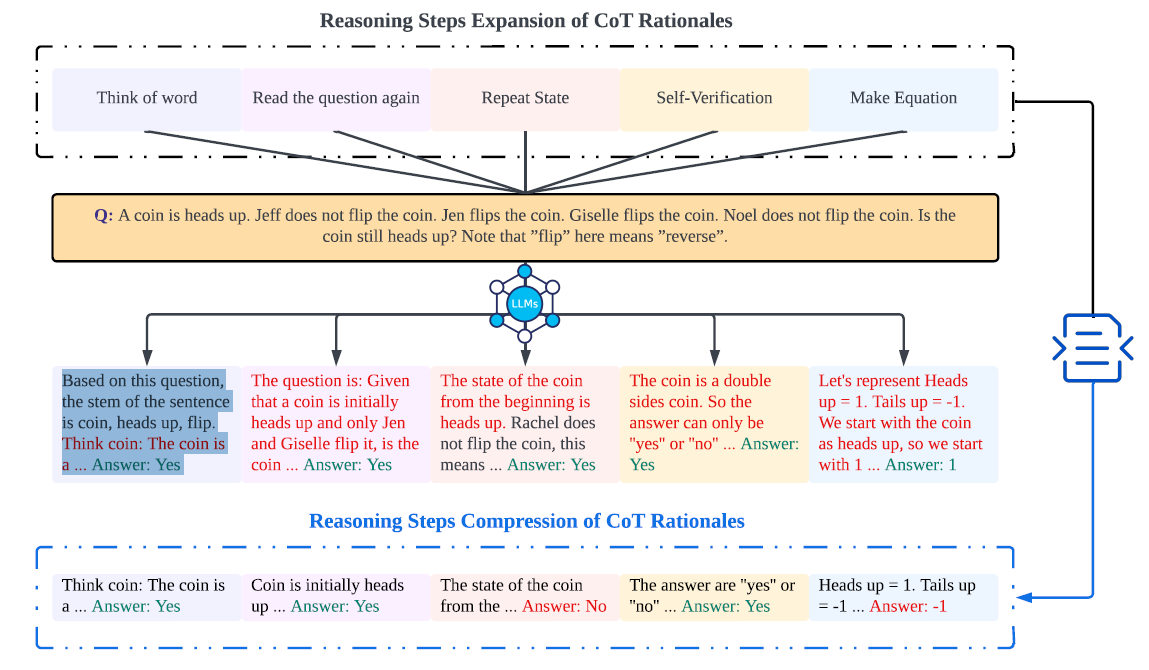
As shown above, the Few-shot CoT in this paper is organized into the following steps:
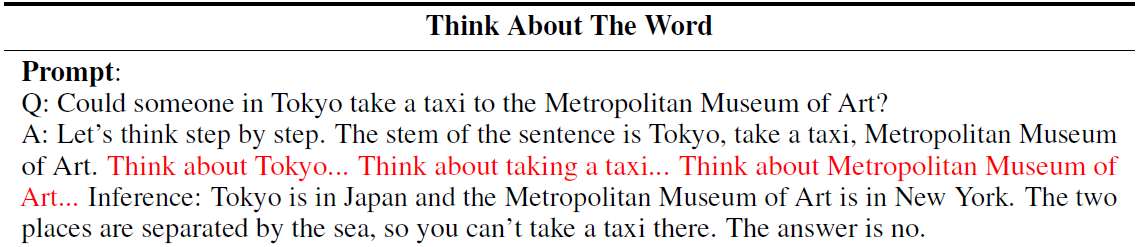
- Think About The Word: the authors first ask the LLM to think about the meaning of the words in the question (work out what each word means before answering). For example, given the question “Could someone in Tokyo take a taxi to the Metropolitan Museum of Art?”, as illustrated below, the authors have the LLM first consider what “Tokyo”, “taking a taxi”, and “Metropolitan Museum of Art” mean — “Think about Tokyo… Think about taking a taxi… Think about Metropolitan Museum of Art…”.
Read the question again: have the LLM read the question once more (review the problem statement again).
Repeat State: have the LLM produce a summary of the question, simplifying what it needs to remember and reducing the influence of the other words in the CoT (extract the key information from the question).
Self-Verification: add a self-verification step in which the model judges, from some basic information, whether the answer is reasonable (think for yourself about whether your answer is right).
Make Equation: for mathematical problems, have the LLM formalize the problem as an equation.
Experiments and Findings
The relationship between step count and accuracy
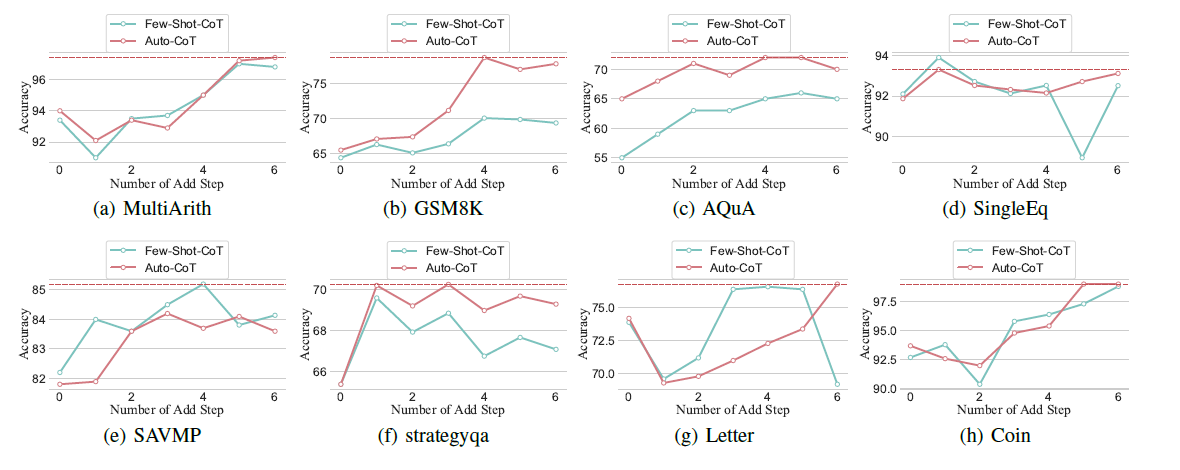
As shown above, in each subplot the x-axis is the length of the CoT chain (the number of reasoning steps) and the y-axis is the LLM’s accuracy. Clearly, the longer the CoT chain, the higher the accuracy. This finding holds across all datasets and tasks.
What happens when one link in the CoT is wrong?
For CoT researchers, the most important question is how to get every step of the chain right so as to arrive at the correct answer. In this section, the authors ask: if one link in the CoT is reasoned incorrectly, how does that affect the LLM’s final result?
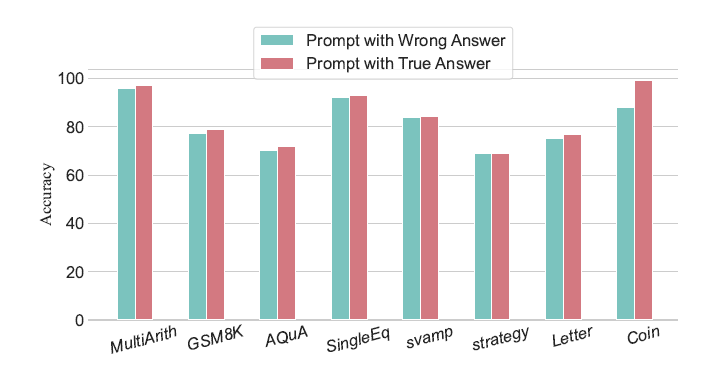
In the figure below, the x-axis denotes eight categories of tasks/datasets, and the two colored bars represent fully correct chains and chains containing an incorrect answer. The authors find that:
- For mathematical problems, an error in one link has very little impact. The authors argue that the LLM learns the computational pattern rather than the result of the computation itself, and is therefore unaffected. An example is shown in the figure below, where the faulty prompt on the right computes
10+8as the incorrect value48. - For logical problems, even a small error breaks the chain of thought and has a large impact.

What happens when the reasoning steps are compressed?
Compressing the reasoning steps here means phrasing each step more briefly. The results show that compression drives performance close to that of Zero-shot, further demonstrating the strong link between reasoning steps and LLM accuracy.
The effect of model size on the results
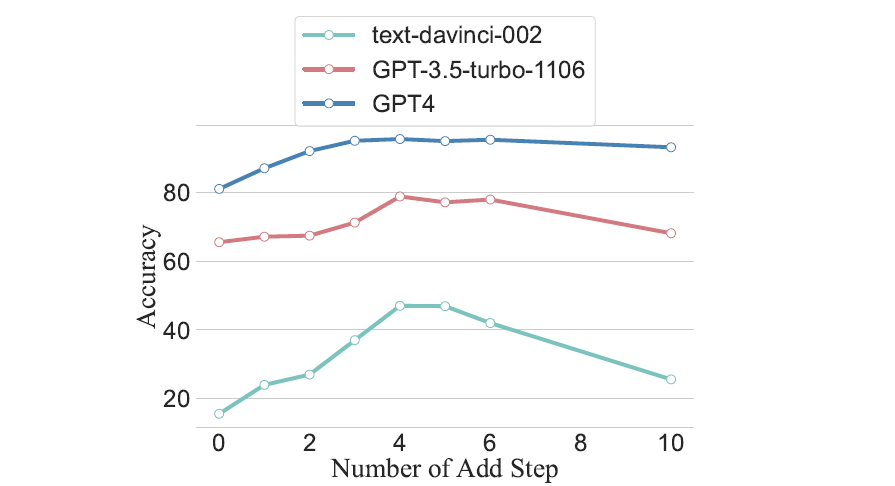
As the figure below makes obvious, the more parameters, the more accurate the model.
Do different CoT generation methods differ much?
Since this paper focuses on the impact of reasoning steps, it first has to confirm that the questions used inside the CoT are not what drives the LLM’s performance.
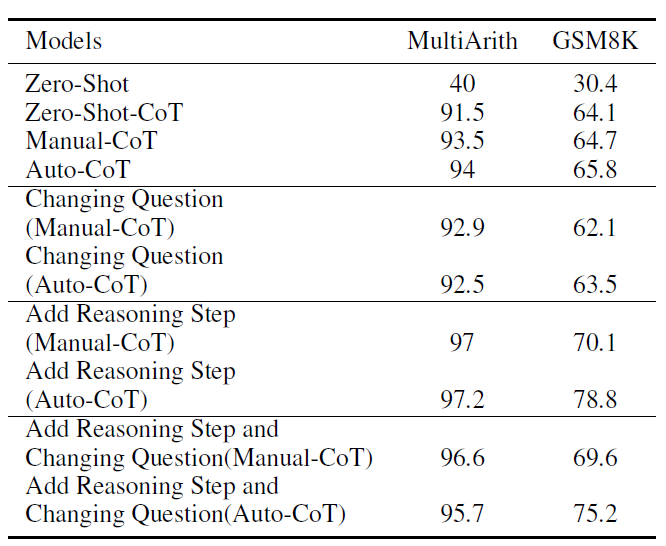
To that end, with the LLM fixed to GPT-3.5-turbo-1106, the authors selected two datasets (MultiArith and GSM8K) and two CoT methods (Auto CoT and Few-shot CoT) for this study.
As shown below, an initial inspection indicates that these modifications have a negligible effect on performance. This preliminary finding suggests that it is the length of the reasoning chain, rather than the nature of the questions themselves, that primarily governs the reasoning ability of LLMs.
Comments
Although this paper is not technically difficult, its evaluation of CoT is thorough, its angle is novel, and it arrives at a good number of interesting conclusions.